Around the World in 500 Words

Political unrest continues in Hong Kong as police and civilian clashes continued on November 11. One protestor was shot as a Chinese policeman wrestled with a white-hooded protestor at an intersection. A black-hooded protestor then came up seemingly to help the other protestor and was shot by the policeman. The protestor who was shot is now in stable condition according to the Hong Kong hospital authority.

Another violent incident that put another individual in critical condition took place in the Ma On Shan neighborhood. A man was lit on fire after being covered in a flammable liquid by another individual. Police are still investigating whether this burning incident is connected to the political protests that have been taking place over the past several months.

Another protest incident occurred the same day, as police used tear gas and water cannons against students protesting at the Chinese University.

N7 (2).jpg

“I do not want to go into details,” said Hong Kong Executive Carrie Lam, “but I just want to make it very clear that we will spare no effort in finding ways and means that could end the violence in Hong Kong as soon as possible.”

The President of Bolivia, Evo Morales, has resigned following several weeks of pressure from the army and other protestors. An election to determine the next president will be scheduled, but for now Bolivia’s interim president will be the deputy head of the Senate.

Morales, the first indigenous leader of Bolivia, had served as Bolivia’s president for three terms beginning in 2006. Last October, he garnered much criticism by running for a fourth term which is technically illegal in Bolivia’s Constitution.

The Bolivian people have been polarized by Morales’s resignation. Some celebrated while Morales’s supporters took to the streets in protest. Several buses have been destroyed, and politicians’ homes have been targeted in the wake of the resignation.

In the Middle East, there is growing international concern about the increase in Iran’s uranium stores. Iran’s accumulation of low-enriched uranium is greater than what the Joint Comprehension Action Plan (JCPOA) allows them to have, according to the International Atomic Energy Agency.

N8 (2).jpg

The International Atomic Energy Agency found that Iran had about 172 more kilograms of low-enriched uranium than they were supposed to. This increase in uranium caused concern among many nations, as it could allow Iran to continue to develop its nuclear program and eventually nuclear weapons.

In a recent attempt to stabilize and secure the northeast state of Borno, Nigerian forces have killed many Boko Haram militants, according to Ghana News. The Nigerian army’s increased attempts to eliminate the Islamic terrorist group from the region have yielded put increasing pressure on the insurgent terror group.

Speaking to reporters, Nigerian army spokesman Aminu Iliyasu claimed that the army was identifying more Boko Haram hideouts and therefore raiding and bombarding them with their better weapons. The Nigerian army has been systematically going after Boko Haram and hopes to eliminate as many militants as it can and to establish safer areas in northern Nigeria. 

The Daily Post has also reported that two individuals who had been hostages of Boko Haram have been recently released. Moses Oyeleke, pastor of Living Faith Church, and science teacher Ndagilaya Umar have both been released.


CRISPR Gene Editing Technology Takes the Next Step Forward

In late October NPR reported on the “CRISPR revolution,” saying that scientists have recently developed an easier way to edit DNA and re-write genes with more ease, precision, and safety than ever before.

N2 (5).jpg

A field of study first initiated in the 1990s and early 2000s, CRISPR was first discovered by Francisco Mojica, a scientist at the University of Alicante in Spain. According to the Broad Institute’s website, he “proposed that CRISPRs serve as part of the bacterial immune system, defending against invading viruses.” Whenever a CRISPR enzyme recognizes a threatening bacterium, it essentially chops up the offending bacterium’s DNA until it doesn’t exist anymore.

In January 2013, Feng Zhang, a scientist at the Broad Institute of MIT and Harvard, successively used a certain type of CRISPR code called CRISPR-Cas9 to edit the genomes in mouse and human cells.

Zhang, in a video posted on the Broad Institute’s website, describes the process as similar to editing a book. If there’s a wrong word in a book—“big” instead of “little,” for instance—simply removing the word “big” doesn’t fix the sentence. It would also be incorrect to simply add in the word “little.” Instead, the editor must both take out the wrong word (“big”) and replace it with the correct word (“little”).

Similarly, Zhang wants to use CRISPR to find and remove genetic mutations in human DNA (the “wrong words,” so to speak), replacing them with normal, healthy sequences (the “right words”) in order to prevent genetic disease.

However, CRISPR-Cas9, while accurate, has its limitations. For instance, it’s unable to correct genetic mutations in cells such as those that carry Parkinson’s and Huntington’s diseases.

New technology overcomes these limitations. David Liu, a biologist at Harvard and MIT, reported to NPR that this technology, called prime editing, “is really a step—and potentially a significant step—towards this long-term aspiration of the field in which [scientists] are trying to be able to make just about any kind of DNA change that anyone wants at just about any site in the human genome.”

The implications of such technology are breath-taking. On the one hand, while many lives could be saved from lethal genetic diseases, prime editing could also have potentially negative effects on patients, regardless of whether those effects occur on purpose or accidentally. 

One primary concern is about the unintended effects of altering a person’s DNA. According to the website SciTechDaily, “a series of studies have suggested that CRISPR may cause cells to lose their cancer-fighting ability, and that it may do more damage to genes than previously understood.” Other unknown consequences could appear as well.

Gene editing also has the potential to be used on embryos in an attempt to create babies that are stronger, healthier, and even more intelligent, a move which could create unfair social disadvantages for those without access to such technology.

It is widely known among the scientific community that CRISPR and other gene editing technology is moving faster than government regulation can keep up with. 

In fact, it was only this past July that Governor Gavin Newsom of California signed the first state law to directly address CRISPR technology. This came as a response to one California resident in the business of selling “DIY gene-editing kits,” one of which was apparently supposed to increase muscle mass when properly applied. 

The new law, to go into effect in January, prohibits “sales of certain do-it-yourself CRISPR supplies...unless they carry a bold notice ‘stating that the kit is not for self-administration.’” according to the website Technology Review. 

Two years prior to this incident, in 2017, the Food and Drug Administration announced that DIY gene-therapy products were illegal. According to their website, the “FDA is aware that gene therapy products intended for self-administration and ‘do it yourself’ kits to produce gene therapies for self-administration are being made available to the public. The sale of these products is against the law. FDA is concerned about the safety risks involved.”

The FDA also cautioned consumers “to make sure that any gene therapy they are considering has either been approved by [the] FDA or is being studied under appropriate regulatory oversight.”

As gene-editing grows faster and easier with new prime editing tech, however, these warnings may go unheeded, requiring stricter legislation.


The Diddly Squat on Democratic Candidates

Tired of not knowing diddly squat about politics? Well, get ready to impress your friends with your knowledge, because boy oh boy do I have an article for you.

2020 is one of those years that, as a kid, sounded kind of weird and made up. It just didn’t compute in your mind; it was too far away and we’d probably never make it. But alas, the decade is ending, and 2020 is nipping at our heels, so it’s time to really pay attention to those upcoming presidential elections, wouldn’t you say?

So, why not be informed this time around? While I will not be giving an exhaustive explanation of each candidate, I (with a little help and information from the New York Times) will be giving you a little snapshot of what a few of the Democratic front runners are doing so far, just to jump start you in your political journey.

N4 (4).jpg

First, Joseph Robinette Biden, Jr., affectionately known as Joe Biden. You may know him as the 47th vice president back in the day, when Barack Obama was in office. Biden is 76 years old (77 on November 20th!) and was born in Scranton, Pennsylvania right next to Michael Scott. But don’t let that fool you, the man is no stranger to politics. Biden is a six-term senator from Delaware, and he has also tried for the Democratic nomination for president in 1988 and 2008. And of course, there’s the whole vice president thing. He’s kind of like your cool, famous grandpa.

Biden’s current national polling average is 28%, making him the Democratic front runner. He is passionate about the issue of health care, and often discusses it in relation to some of his own personal tragedies, including the loss of his first wife and daughter in 1972 and the loss of his son in 2015. Along with the issue of health care, the New York Times states that some of Biden’s other signature issues are, “Restoring America’s standing on the global stage [and] strengthening economic protections for low-income workers in industries like manufacturing and fast food.” Ladies and gentleman, Mr. Joe Biden. *applause*

N5 (6).jpg

Close behind Biden, with a national polling average of 20%, is Elizabeth Ann Warren, affectionately known as Elizabeth Warren. The 70-year-old Massachusetts senator and former Harvard professor is known for “having a plan.” Seriously, she has released detailed plans that could potentially reshape and restructure the economy, and her phrase “I have a plan for that” has even made an appearance or two on t-shirt designs. You may also know her as that candidate who takes selfies with everyone. That’s right, Warren spends hours at the end of her town hall meetings at the front of her “selfie line,” where anyone and everyone can quickly and efficiently have their picture taken with her and shake her hand. Maybe that seems a little silly to some, but in a world of social media, this has proved to be an effective mode of spreading her name and message to those across America, as well as helping her stand out among competitors. She’s kind of like your cool, hip grandma.

As an expert in bankruptcy law, Warren also knows her stuff. She helped set up the Consumer Financial Protection Bureau during the Obama administration, and is known for her policy plans, including “creating a wealth tax, canceling student loan debt for most borrowers, and breaking up big technology companies,” according to the New York Times. Warren is passionate about income equality and political corruption, as she sees big corporations attacking the middle class. Let’s also not forget that she is a woman, and a woman has never become president. A history-making election, if she makes it. Ladies and gentlemen, Ms. Elizabeth Warren. *applause*

N6 (3).jpg

For our third and final candidate, coming in with a national polling average of 17%, we have Bernard Sanders, affectionately known as Bernie “Feel the Bern” Sanders. A theme so far in these three candidates is that they seem to know what they’re doing, and Sanders is no exception. Sanders was elected to the House of Representatives in 1990 and is the former mayor of Burlington, Vermont (not to be confused with the Burlington Coat Factory), as well as a senator from Vermont. Something definitely worth mentioning is that Sanders is 78 years old, which means that if he were to be elected, he would be the oldest president in history. I will say that, if Joe Biden or Donald Trump were also elected, they too would hold the title of oldest president in history. However, Sanders takes the cake, because he is older than both. He’s kind of like your cool, really old grandpa.

Sanders, runner-up to Hillary Clinton in the 2016 Democratic primary, has many topics and ideas that he is trying to push forward. First, Sanders is a self-proclaimed democratic socialist. While the exact definition of this term is a little tricky, democratic socialists do not support capitalism, meaning that “they want workers to control the means of production,” according to the New York Times. They also believe that socialism should be achieved via democracy, hence the term democratic socialist. Sanders is also known for his “Medicare for all” platform, as well as pushing for tuition-free public college. Ladies and gentlemen, Mr. Bernie Sanders. *applause*

These are brief insights into your top 3 Democratic candidates, but let me remind you there are 14 other Democrats currently running. So remember to stay informed, exercise your right to vote, and keep doing your best!


The Impeachment Inquiry: Recent Developments

N9 (2).jpg

The impeachment investigation of President Trump was launched roughly a month ago due to a whistleblower complaint. The complaint said that Trump abused his power for political gain by pushing the Ukranian president to investigate former-Vice President Joe Biden. Democrats have issued several subpoenas and requests for documents and testimonies in order to proceed with the investigation. 

On October 31, the House voted to make the impeachment inquiry formal. It passed in a 231 to 194 vote with no support from Republicans and three abstentions. Only two Democrats voted no on the formalization and there was one abstention. This opened up a new public side of the investigation.

The vote approved a resolution that would set out rules for an impeachment process. Democrats had been investigating the issue behind closed doors for evidence and heard testimonies for about five weeks before the vote. Now that evidence is slowly being made public. 

Gordon Sondland, ambassador to the European Union and ally to Trump, provided an important testimony last month on October 3. His original testimony stated that there was “never” a precondition on the military aid that was sent to Ukraine. This opposed many of the statements that had gone out, saying Trump put a quid pro quo on the aid. 

Quid quo pro essentially means “thing for a thing,” or giving someone something they want but only when they give you what you want. The debate between the House is focused mainly on whether or not Trump put a quid pro quo on the aid he withheld from Ukraine, making them first investigate Biden for his own gain. 

On Monday November 4, Sondland changed his testimony and, in a three page addendum, said that the aid to Ukraine was in fact linked to the investigation of corruption in the country. He said that it was actually he who offered the quid pro quo to a Ukranian official, telling them that they probably would not get the aid unless they publicly announced the investigation Mr. Trump wanted.

Sondland’s argument was that two other recent testimonies he heard had “refreshed his memory,” according to NPR news. This boosted the Democrats’ argument that Trump did put a quid pro quo on the aid, and angered Republicans who believe Sondland betrayed Trump by going back on his word. 

Trump has not expressed any worries about the ongoing investigations. According to the New York Times, he said, “I’m not concerned about anything. The testimony has all been fine.” He also said many of the witnesses were people he did not know or who do not support him. When asked about Sondland he said “I hardly knew the man.” 

Mick Mulvaney, the acting White House Chief of Staff, said last month in the White House briefing room that a quid pro quo did link the aid money to investigation and that reporters should “get over it,” according to the New York Times. He retracted this statement a few hours later. 

Trump said in a tweet from November 3 that “False stories are being reported that a few Republican Senators are saying that President Trump may have done a quid pro quo, but it doesn’t matter, there is nothing wrong with that, it is not an impeachable event. Perhaps so, but read the transcript, there is no quid pro quo!” 

As the investigation moves forward, a new defense approach is being taken by Republicans and Trump. Most Republicans who have been against the impeachment have said that Trump did not put a quid pro quo on the aid. With all the new evidence coming forward that may suggest differently, some are now saying that even if he did, it is not grounds for impeachment.


Rising Sea Levels Will Be Three Times Worse Than Previously Thought

Scientists at Climate Central, a New Jersey-based research center, have published a new model for estimating coastal elevations, which predicts that the effects of sea-level rise could be three times more severe than previous estimates. Under these new models, as many as 340 million people will live below annual flood levels by 2050. By the end of the century, land currently occupied by 190 million people will be below high-tide levels, assuming the lowest levels of carbon emission. The results of this new model have immense scientific, geopolitical, and economic implications.

N12 (1).jpg

Publishing late last month in Nature Communications, computational scientist Scott Culp and ecologist Benjamin Strauss introduced a new, substantially more accurate method for finding the elevation of land in coastal areas. Using global satellite-based elevation data, along with airplane LIDAR of coastal regions of the United States, the authors trained a neural network to correct for obstacles such as buildings and trees that can impede a satellite’s vision of the ground. They found that previous satellite models, which had not used machine learning, substantially overestimated the safety of many coastal areas. Remarkably, the best-case scenarios under the new model (named CoastalDEM 1.1) are worse than the worst-case scenarios under old models.

These results have an exceptionally high degree of urgency for cities in Asia, where a dangerous conjunction of inaccurate mapping and low-lying coastal population centers puts millions of people at increased risk. More than one-quarter of the population of Vietnam (20 million people) is estimated to live below high tide levels by 2100. Substantial portions of Bangkok, Mumbai, Jakarta, the Pearl River Delta, and coastal Bangladesh will also be inundated. The effects aren’t limited to Asia, however. CoastalDEM also places Basra (Iraq) and Alexandria (Egypt) underwater. Notably, these effects will occur even under the most conservative estimates of sea-level rise, underscoring the serious inaccuracy of previous predictions.

There will be two primary effects of this worsened flooding. First, in areas that can afford it, enormous expenditures will be necessary to construct seawalls, dikes, levees, and flood control infrastructure. The impact on economic productivity from these constructions could be severe. Notably, CoastalDEM shows that 110 million people already live below high tide levels, in population centers like Amsterdam and Shanghai. This resistance to increasing sea levels is possible thanks to technological innovations that protect populated areas from flooding. However, flood control can fail. Speaking to the New York Times, Strauss pointed to the effects of Hurricane Katrina, which overwhelmed New Orleans’s levee system and killed almost 2,000 people. The question, he told the Times, is “How deep a bowl do we want to live in?”

Second, in areas where billion-dollar flood control efforts are not feasible (likely the majority of inundated areas), a new refugee crisis could emerge. Escaping from inadequate infrastructure and increasing natural disasters, coastal dwellers around the world may begin to move inland, potentially overwhelming the capacity of inland communities. Climate refugees will become an increasing share of the global migration crisis, compounding previous geopolitical stress, adding new regions of concern, and extending the current surge of migration into the 2100s.

In the 20th century, sea levels rose by 11-16 cm globally, almost entirely attributable to climate change. In the 21st century, there are concerns that the Antarctic ice sheet may begin to destabilize under rising temperatures, potentially leading to increases in sea levels as large as 2 meters. However, even without this contribution from the southern ice cap, sea-level rise will still reach as much as 50 cm by 2100 under the most optimistic carbon emission estimates. 

Climate change is a preeminent threat to global security, economic productivity, and development. This surprising new model, which points to an increased effect for just one aspect of climate change—sea level—underscores the urgency of climate action and the risk of continued irresolution. 

This article is based on the paperKulp, S.A., Strauss, B.H. New elevation data triple estimates of global vulnerability to sea-level rise and coastal flooding. Nat Commun10, 4844 (2019) doi:10.1038/s41467-019-12808-z. Climate Central also provides a very helpful visualization tool on their website, which is available at coastal.climatecentral.org.

Tad Evearitt Wins Rudy and Collyn Schmidt Service Award

N13.JPG

During chapel on November 1, Tad Evearitt, graphic designer for the Marketing and Communications department, received the Rudy and Collyn Schmidt Service Award for his service to the college. Several students flashed hall signs as Evearitt smiled for his presidential selfie.

“Covenant’s a much healthier place because of Tad’s years of faithful service here,” President Halvorson said.

Rudy and Collyn Schmidt moved to Lookout Mountain with the college in 1964. They helped found New City Fellowship in a YMCA on south Chattanooga’s Mitchell Street, where Evearitt attended as a young boy. At Covenant, they spent decades working often low-profile jobs that were vital to enriching the student experience and advancing the effectiveness of the college.

The award, named after the Schmidts, originated a few years ago, when the administration was searching for a way to honor exemplary employees who follow the Schmidts’ legacy in promoting Christ-like service. Since then, past winners have included head men’s soccer coach Scott Bosgraaf in 2018, campus architect David Northcutt in 2017, and Alumnus of the Year Bob Harbert in 2016.

 “We wanted a way to recognize folks, and acknowledge their good service to the college, and naming an award after Rudy and Collyn Schmidt made a lot of sense,” said Halvorson.

When it’s time to choose candidates for the annual award, Halvorson says the entire staff of the college is included, as they are asked who has most exemplified these qualities.

Evearitt himself recalls “Aunt Collyn’s” generosity in frequently hosting students at her house, even in her old age. Having grown up here on Lookout Mountain, he has been involved with Covenant since his youth, with his father teaching in the Education Department.

After graduating from Covenant in 1998 with a major in Sociology and a minor in Biblical and Theological Studies, Evearitt now lives with his wife and four children near Cloudland Canyon State Park, where he can often be found outside with his family. He loves reading books and listening to podcasts, striving to constantly advance himself through his love of learning about a variety of subjects.

Evearitt will have worked for Covenant twenty years this January, during which President Halvorson says he has impacted every department on campus. Beginning in Technology Services, he honed his problem-solving skills and advanced into web development and electronic media.

Evearitt’s work consists of designing projects for multiple channels including email, print, apps, and web. While largely a student of typography and design principles, he analyzes the college’s marketing strategies and diagnoses various problems from his position in project management.

Evearitt says his former director and colleague Jen Allen, among others, was instrumental in his growth at Covenant College, and he accepts the award with humility in regards to both his coworkers and the Schmidts.

“I’m not in the same universe as these people,” he says of Rudy and Collyn Schmidt. “Where needed most, that’s where they were.”

Marketing and Communications Director John Horton, who arrived at Covenant two months ago, says Evearitt took the unique initiative of anticipating things before they happened. Before Horton moved to the area from Orlando, Evearitt was accommodating his arrival through email inquiries, the setting-up of his office, and the ordering of business materials.

“He personifies what Covenant College stands for,” Horton said, adding that he was not at all surprised when Evearitt won.

For Evearitt, the work he does is all about the meaning and vision of Covenant College, as he strives to explore and proclaim the preeminence of Christ in all things. One of his favorite quotes, by Abraham Kuyper, says, “There is not a square inch in the whole domain of our human existence over which Christ, who is Sovereign over all, does not cry, Mine!”


Hall Cup: How It Came to Be and Where It Is Now

In the beginning, there was Brad Voyles.

“He just thought it would be a cool idea to involve halls in different competitions and kind of build this sense of camaraderie and healthy competition across campus,” said Emily Balint, Coordinator of Student Leadership.  “He brought [the idea] to the person who was in my position at the time and together they created what is today the hall cup.”

First introduced in the 2017-2018 school year, Hall Cup events were originally stand-alone events.

“There was a minute-to-win-it competition, an individual trivia night that was separate from the other trivia nights—that year they were trying to really set Hall Cup apart from other events on campus,” said Balint.  

However, with an already full event calendar, attendance remained minimal, and the following school year (2018-2019), Balint slowly incorporated Hall Cup events into pre-existing ones. The change came with mixed reviews.

“In the past, Hall Cup has been very sports-dominated,” said Leila Vaughn, Resident Hall President of Founders. “Nobody seemed super interested in them.”

Jonathan George ’21, Resident Hall President of Maclellan-Rymer, shared similar sentiments.

“Last year I was aware of [Hall Cup],” said George. “I knew there were some events, like sporting events that you could go to and get points, but I didn’t really participate in it… Nobody really seemed to take it seriously.”

For Vaughn, who found that last year’s Hall Cup events often revolved around sports events, getting involved was hard.

“I’m not that interested in sports,” said Vaughn. “Like, I would go if I had some really good friends playing, but I didn’t really go to any Hall Cup events last year. Maybe a trivia night or two, but I wasn’t really interested in the sports events.”

As Vaughn noted, however, last year’s numerous sports-related events make sense when the Covenant’s student demographic is taken into consideration. According to her, approximately “45% of the student body are athletes, so it’s very hard to accommodate for other events when athletics happen all year long and almost half of [Covenant’s] student body are athletes.”

Since last year, however, the presidents of each building have begun meeting weekly with Balint in order to discuss ways to vamp up events and increase student participation.

“Every Monday we discuss what events we’re planning as a building, working together to make sure our schedules don’t conflict and also working on Hall Cup Stuff,” said Vaughn.

For George, the fruits of these efforts are already evident.

“Coming in this year, [the Resident Hall Presidents] were really excited to branch out to theater events, music events, and hall events as well,” George said, “which meant people from different parts of campus could get involved and people are enjoying it a lot more. They’re also taking it more seriously, especially after [the RHPs] have upped the bragging rights with the trophy and the banner.”

Vaughn also feels more optimistic this year, both about getting her fellow classmates involved and helping advertise exciting events on campus.

“I’m hoping that the wider variety of events this year [i.e. not just sports events] people will get more excited,” she said. “It’s been bothering me that the theater and music departments don’t get a lot of recognition outside of the people who are already involved in them and this year we’re trying to change that.”

As Voyles’ idea slowly comes to realization, George observes the change in attitude of his own dorm building towards Hall Cup.

“The purpose of Hall Cup is to build school spirit and camaraderie,” said George. “I think sometimes people look at Hall Cup and say, ‘Oh, we’re just trying to rip off Harry Potter.’ Which, granted, we are doing a similar thing, but at the same time these events are actually encouraging students. In Mac, we’ve really gotten behind the idea of building unity, and seeing that is really fun.”

At the end of the day, one of the biggest goals of Hall Cup is to have fun while hanging out with people from across campus. If that’s accomplished, Hall Cup is a success. For George, achieving that kind of success is part of what makes his job as building president fulfilling.

“I enjoy seeing the people from my building show up [at Hall Cup events] and having them come up to me to let me know they’re present,” he said. “It’s super encouraging for me and it’s super fun to see that the people in Mac don’t see [Hall Cup events] as something ridiculous but as something worthwhile.”

Currently the Hall Cup standings are as follows: Mac in first place with 375 points, Andreas/Apartments with 225, Founders in third with 200, and Carter with 175. Upcoming events include a costume contest at Quest Kilter on November 1 and attendance for the upcoming “Tartuffe” play on November 15-16.


Arounders

You walk up and scan your Scots Card to hear the beep of the door opening. It’s familiar; you’ve been here before, but it looks different. You walk in and are overcome with a wave of hot, sticky air. The room is crowded and loud. Demogorgons cover the walls. You see people waiting to pass through a doorway into the heart of the building. You’re just a corporate drone, so you fall in line and wait to enter. 

Student Body President Erik Peeples ’20 mans the door and allows small groups of people to gain access to what lies ahead, never to be seen again. The line moves, and you inch closer and closer to the door. Your heart is racing. What is this? you ask yourself through your nervous thoughts. I jump in. “This,” I say, “is Around Founders.”

That’s right folks, on Saturday October 26th the annual event of Around Founders took place, and it was quite a ride. Each hall in Founders spent hours decorating to create impressive 80s themed spaces, in the end becoming unrecognizable as college dorm room halls. In past years, there has even been gravel, hay, and water covering the floors of some of halls. 

Jubilee RA Beebe Stroud ’22 gave us a little bit of insight into her hall and the effort exerted. Jubilee turned their hall into your friendly neighborhood Blockbuster, showcasing 80s movies like “Ferris Bueller’s Day Off,” “Ghostbusters,” and “The Shining.” Stroud said that her hall had been discussing Around Founders about a month in advance, and many of the Jubilee residents gathered supplies from their homes over fall break in order to prepare.

“I think the best part of the experience was seeing people's faces as they walked through,” said Stroud, “It was especially nice to see all of our hard work pay off when people got excited or spooked in our hall.” Stroud also said that her hall began decorating early Thursday night and continued to decorate all of Friday and Saturday until the work was complete. Talk about commitment.

Jubilee won second place for their Blockbuster theme. Ekklesia won first place for their theme of the movie “Aliens,” and Highlands won third place for their creative theme of  “complete independence of commonwealth countries from the UK” (shoutout to Mary Grace Donaldson ’20 for explaining their amazing and hilarious theme). Gracewell won People’s Choice and Most Aesthetic for their “Princess Bride” themed hall, and Catacombs won Most Authentically 80s for their MTV decorated hall. 

Jackson Lyda ’22 of the Combs explained that, in contrast to Jubilee, Catacombs took about a day to prepare for Around Founders and about 10 hours to decorate. Lyda said that his favorite part of the experience was, “listening to ‘Remain in Light’ for twenty-four hours to get into character.” You can’t say that isn’t commitment.

Other halls that also did a spectacular job and leaned into the 80s theme were Balcony with their Pac-Man theme and Blackwatch with their theme of the Berlin Wall. Will Siegenthaler ’20, a former Catacombian, was really struck by Brethren's Time Machine Stuck in the 80s theme. “The caveman room was hysterical,” said Siegenthaler, “and the 2180 nuclear fallout room followed by the alien experimentation room was an incredible one-two punch.” 

This was Siegenthaler’s first year to be an observer in the event instead of participating, which definitely has its perks. He was not totally thrilled with the experience of hours of decorating and cleaning up the hall, and said that “being an observer is nice because you have no stakes in the outcome, and you can just walk through and see everything.” Siegenthaler would also like to take this time to apologize to Gracewell for taking their large container of cheeseballs.

Around Founders is a cherished and well-loved event by many, but especially by those in Founders. “People work really hard on their halls and it brings a lot of hall unity and building pride,” said Stroud, “Founders is a very creative and quirky place, and Around Founders is a really fun way for the building to show off its strong suit to the campus.” 

Although Siegenthaler now enjoys being off campus and simply coming to observe and support the event, he did mention that he always had a good time participating with his hall. He does, however, have an important word of critique, for anyone taking notes. Although the popcorn in the lobby added a touch of class and elegance, Siegenthaler says that “there was so much body heat and sweat in the room that the popcorn was damp.” Don’t worry, Founders, we really appreciated the effort either way, and still ate the damp popcorn out of politeness. It really fit the quirky vibe, but perhaps less damp popcorn would be the way to go next year.


Around the World in 600 Words

On October 27th, President Trump announced that Abu Bakr al-Baghdadi, a prominent leader of ISIS, had been killed in a U.S. Special Forces raid in Northwest Syria. When apprehended, Baghdadi killed himself and three of his children by detonating a suicide vest. While eleven ISIS operatives were killed in the raid, there were no U.S. casualties.

“Baghdadi was vicious and violent,” President Trump said upon announcing Baghdadi’s death, “And he died in a vicious and violent way, as a coward, running and crying.”

Since 2014, Baghdadi had been in command of ISIS. Their goal was to create a global Islamic caliphate. His forces pursued this objective by fighting their way across Syria and Iraq, specifically targeting religious minorities and destroying many historical monuments.

Westerners in the region had also been a target for ISIS forces. One humanitarian worker from the U.S. was kidnapped by ISIS. It is believed that Baghdadi violated and murdered the humanitarian worker after she was forced to marry him. According to CNN, the U.S. military named the mission to eliminate Baghdadi after her.

Across the globe, protests in Chile have turned violent as nearly 1000 protestors gathered in Santiago. The media has criticized police for an excessive use of force. These protests have served to cripple public transportation as people try to commute to and from work.

Advocating for more social services and greater political equality, the protestors are demonstrating against the government of President Sebastian Pinera. Pinera has attempted to pacify the protestors by putting more moderates in his cabinet including the leaders of Chile’s interior, treasury, economy, and labor department. These actions have not satisfied the protestors.

“Last Friday we had a peaceful protest and being peaceful they didn’t listen to us,” a 25-year-old welder told the AP, “You have to get their attention somehow.”

In Nigeria, officials have raided The Koranic and Rehabilitation Center, a private Islamic boarding school in Daura. Described as “torture houses” by officials, this school and several others were advertised as places for parents to send their drug-addicted or otherwise troubled children. 

The children at these schools lived in horrific conditions. They were chained in their rooms and had to eat and sleep in the same area in which they went to the bathroom. The children were also reportedly violated by staff members.

Though many of those enslaved at the center had escaped, police rescued 67 boys and men from the school in Daura. There have been several raids in the region recently to these rehabilitation centers, with many turning out to be centers of abuse. 

“People believe that these schools have the spiritual power to heal,” says Jaafar Jaafar of The Daily Nigerian, “they don't mind how much the children are dehumanised, or how they're treated, as long as their child receives a Koranic education and is rehabilitated."

A Global Prayer Vigil for captured Nigerian school girl Leah Sharibu was held on October 26. The vigil was organized by “Save the Persecuted Christians” and the “Leah Foundation.” Sharibu has been in the hands of the Islamic terrorist group Boko Haram since February 19, 2018.

N6 (2).jpg

While Sharibu was originally captured with around 109 other school girls, she alone still remains prisoner. The reason for her imprisonment is her refusal to convert to Islam and renounce Christianity.

“We join the human rights community and faith leaders from around the world in praying and advocating for Leah and all the other school children held captive by Boko Haram,” said Dede Laugesen, Director of Save the Persecuted Christians. 


“Scotstainability:” How Covenant is Becoming Greener and More Efficient

Last August, a little-known school girl sat outside the Swedish Parliament doors holding a sign that read, “school strike for climate” (translated from Swedish). Her simple action would trigger climate strikes across the world, including here in Chattanooga on September 20. Greta Thunberg’s movement is becoming influential on Covenant’s campus, resulting in multiple climate articles written and increasing discussions on climate change in general. 

Earlier, the Bagpipe talked with Campus Stewardship Committee (CSC) Recycling Coordinator Zoe Kiratzis ’21, who also attended the climate strike in Chattanooga on September 20. She talked about how—thanks to the advocacy of the Campus Stewardship Committee—the administration has begun to start providing the Committee with the money and resources to expand recycling efforts. However, she said, “There is so much more we can be doing on campus.” 

Will Payne ’20, the head of CSC, echoed these statements, but also provided information on the current status quo of sustainability projects on campus. “Recycling used to be paid for out of the student activities fee, which was a burden for an already-stretched Student Senate budget. Now,” according to Payne, “as of last semester the administration pays for recycling.” 

This has two immediate impacts in that it clears up room for Student Senate to fund more activities around campus, but it also means that recycling and sustainability is being taken more seriously by the administration. “CSC’s overarching goal is to have Covenant College pay for and maintain a single stream recycling program for every building; that’s been our goal for the past five years or so,” said Payne. 

But what exactly is Covenant doing to become sustainable and greener beyond recycling? Director of Facilities Management Corey Dupree said that Covenant is already implementing multiple ways to improve its sustainability and energy efficiency through the implementation of Building Automation Systems (BAS), reconfiguring HVAC systems, upgrading lighting technology, and increasing the insulation value of buildings on campus.

According to Dupree, BAS is “a glorified programmable thermostat for an entire building. Its controlling lighting, HVAC (heating, ventilation, and air conditioning) systems, and turning things on and off throughout the building. Its coordinating functions in the building to save on energy consumption.” 

Dupree also mentioned how Facilities has implemented utility tracking software which assists them in measuring building performance in order to further leverage new BAS for better effectiveness. With this data, Facilities can then determine ways to improve the energy efficiency of the building BAS as well as measure the effectiveness of other energy conservation projects undertaken. 

One example of how they have done this with notable success so far is in Carter Hall. Using the new tracking software, they were able to identify significant savings in winter heating costs as the renovation of Carter Hall restored the building’s envelope, which increased the buildings “r-value” (or its insulation rating). 

“The old skin of the building had a lot of air infiltration, so in the winter you were spending a lot of gas to heat the entire building, and we saved a fair amount of gas last winter because the building is now sealed up,” said Dupree. Other success stories can be found in buildings like Jackson, where all that was needed was a simple reconfiguration of the HVAC system, which saved the school $200 in energy use per month.

Going forward, Dupree talked about what Facilities has planned in the near future. “Lighting changes is another thing on the docket, which is a much simpler equation [than BAS] in determining potential savings.” “Anywhere customers of our size can save on energy, means there’s less need for new [power] plants,” said Dupree.

When asked about how students can assist in recycling or energy conservation, Dupree said, “If people throw trash into the recycling dumpster, and it reaches a certain percentage of trash, we have to pay for that entire dumpster as if it were trash, and not recycling.” Not only does it cost the school more, but it also goes straight to a landfill. “We save nothing and help nothing” said Dupree. 

CSC also plans to ramp up its sustainability and stewardship initiative. At the end of the interview, Payne said, “We want to associate stewardship with liturgy. We are talking to the chapel department to try and integrate the two in some way,” and that “we need to continue sponsoring events, speakers, and opportunities for students to engage and see others engage in this to help create awareness.”


California Forest Fires Rage On

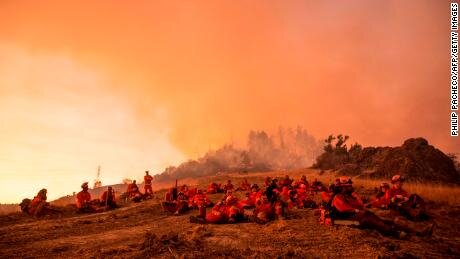
Over the weekend of October 25, the power company PG&E cut power to hundreds of thousands in northern California in an effort to prevent forest fires. Despite this, wildfires are emerging all throughout the state of California. Strong winds and low humidity have created the worst kind of weather conditions for wildfires. Over 90,000 buildings covering an evacuation zone are in danger of being burned down. 

PG&E is facing bankruptcy due to dozens of previous wildfires started by their equipment. They have focused on the strategy that involves shutting off power to customers in areas where weather conditions threaten their electrical equipment. However, people raised more questions when PG&E’s computer system crashed twice and customers couldn’t reach their website just a few weeks ago. 

According to the New York Times, president of PG&E William D. Johnson stated in a news conference, “I understand power shut-offs can be frustrating and make people angry… the fire risk has grown exponentially in the last couple of years.” 

Californians, including the governor himself, have criticized PG&E for their lack of preparation before the fires started. The governor of California, Gavin Newsome, said in a New York Times article, “I must confess, it is infuriating beyond words. They are not meeting the protocols.” 

Newsome declared a state-wide emergency on October 27 due to the continuous presence of strong winds. According to NPR, he said, “We are deploying every resource available, and are coordinating with numerous agencies as we continue to respond to these fires.” 

The Kincade fire that broke out in Sonoma County doubled in size on October 28. Local authorities previously ordered over 180,000 people to evacuate from its path. As of October 30, only 15% of the fire is contained, and it has burned more than 117 square miles. That is more than twice the size of San Francisco, which covers roughly a 47-mile area. 

The Getty fire, which ignited in the hills of northern Los Angeles, has burned around 618 acres of land so far. This fire broke out around 1:30 a.m. right next to Interstate 405, the busiest highway in the United States. Social media was swarmed with posts from people having to evacuate their homes, including Lebron James and former California governor Arnold Schwarzenegger. 

A tweet from Schwarzenegger on October 28 said, “We evacuated safely at 3:30 this morning. If you are in an evacuation zone, don’t screw around. Get out. Right now I am grateful for the best firefighters in the world, the true action heros who will charge into the danger to protect their fellow Californians.” 

A major art museum in Getty was dangerously close to the fires. The Getty Center is a billion-dollar complex that houses an art museum with works from people such as Rembrandt, van Gogh, and Monet. Peter Sanders, a fire department spokesman, remarked that “There is no longer an imminent threat to the Getty Center.” Air tankers dropped fire retardant on the canyons to the west ahead of the fire to create a barrier and keep it intact. 

In 2017 and 2018, some of the very same regions were affected by wildfires in California. A neighborhood in Santa Rosa called Coffey Park was almost destroyed in wine country fires from two years ago. It has been fully rebuilt, but now with the Kincade fire just a few miles away people are afraid of the worst happening all over again.

The New York Times posted a letter from a girl who lives two hours from the Kincade fire. She said, “There seems to always be a fire burning in California. Last year, during the Camp fire, my school cancelled classes, which was unheard of at the time… I am 16. I should not have to worry about the air quality or whether my power will be shut off. More preventative measures must be taken to prevent future fires, so that we never have to experience this again.” 


DNA Testing in Death Penalty Cases

On November 18, a Tennessee criminal courts judge is expected to rule on the posthumous use of DNA testing on evidence that could exonerate Sedley Alley, a man who was denied DNA testing and was executed by the state of Tennessee in 2006. Two days later, on November 20, Texas is expected to execute Rodney Reed, another man hoping for DNA testing of evidence related to his case.

Sedley Alley

In 1985 Alley was arrested for the rape and murder of Lance Corporal Suzanne Collins. In 1987 a jury took less than three hours to convict him and sentence him to death.

Initially Alley denied involvement, but he ended up giving a confession. He confessed to drinking heavily on the night of the murder, accidentally hitting Collins with his car, and trying to help her while holding a screwdriver, which she fell on. However, none of these details from his confession matched details from the autopsy and crime scene. As for the details that did match, interrogators later admitted that they suggested answers to their questions during Alley’s interrogation. In 2004 Alley recanted his confession, saying it was coerced.

Physical evidence also failed to implicate Alley. According to the Innocence Project, a non-profit legal organization that works to exonerate the wrongfully convicted, tire tracks from Alley’s car did not match tracks from the crime scene, nor did the shoe prints from the scene match his. A key witness described the likely perpetrator as having a dark complexion, short dark hair, and a height between 5’6” and 5’8.” Alley was 6’4” with long red hair and a light complexion.

Several weeks before Alley’s execution, his lawyers requested that evidence be tested for DNA. The Tennessee Parole Board agreed and recommended that then-Governor Phil Bredesen halt Alley’s execution until the evidence could be analysed. Although Bredesen had to power to do this, he deferred to the Tennessee courts. There, prosecutors argued that the request for testing was merely an attempt to delay execution and that finding someone else’s DNA would not be enough to exonerate Alley. The court denied the request based on a now-reversed interpretation of the Post-Conviction DNA Analysis Act of 2001.

On June 28, 2006, Alley was executed by the State of Tennessee.

In 2011, the Tennessee Supreme Court ruled that Alley did have a right to post-conviction DNA testing.

Years later, his daughter still wants closure. In April she filed a petition to the Criminal Court of Shelby County, TN to run DNA testing on the evidence that is still in its possession. Tennessee has responded to her petition arguing that the request for DNA analysis should be denied because the Post-Conviction DNA Analysis Act only allows the convicted person to petition, so a relative does not qualify.

Supporters of the death penalty like to argue that there are no confirmed cases of the US executing an innocent person, especially in modern times. As Justice Antonin Scalia wrote in 2006, “If such an event had occurred in recent years, we would not have to hunt for it; the innocent's name would be shouted from the rooftops by the abolition lobby… [As] far as anyone can determine (and many are looking), none of the cases included in the .027% error rate for American verdicts involved a capital defendant erroneously executed.”

This argument makes sense, but it falls short without the possibility of someone being exonerated after execution. If only the convicted person himself has the right to DNA testing, then once he is executed, his guilt or innocence can never be proven with a DNA analysis.

On November 18, a Tennessee judge is expected to rule on Alley’s daughter’s petition for DNA testing.

As Kate Prince wrote on the Tennessee Bar Association website, “If testing were to clear Alley of the crime, it would mark the first time that DNA testing has exonerated a person posthumously in the United States.”

Rodney Reed

In a racially-charged 1996 case, Rodney Reed, an African American man, was convicted of raping and murdering Stacey Stites, a white woman. Reed was given the death penalty by an all-white jury. 

The only evidence connecting Reed to the crime was the presence of three of his sperm cells in Stites’ body. Reed has maintained since his arrest that this was because he and Stites were having a consensual affair. Prosecutors dismissed this claim, and they largely relied on forensic testimony to establish their timeline that Reed raped Stites right before he killed her. 

However, by 2017, those original expert testimonies had all been either recanted or disproven. At least four well-respected forensic pathologists believe it is medically and scientifically impossible that Reed is guilty.

No witnesses came forward about their knowledge of Reed and Stites’ affair during the initial trial. However, since Reed’s conviction, multiple people have said they knew about the consensual relationship. As of October 25, three witnesses have also come forward with new testimony against Jimmy Fennell, the original suspect in the case. 

Fennell is an ex-police officer who was engaged to Stites at the time of her murder. According to witnesses, he threatened to kill Stites if she ever cheated on him, and he used racial slurs when he discovered his fiance was having an affair with a black man. He gave contradicory accounts of where he was on the night of the murder. When asked to explain this to the court, he invoked his right to remain silent.

Fennell has a history of violence against women; since Reed’s conviction, he was sentenced to 10 years in prison for kidnapping and assaulting a woman while he was on-duty as a police officer. 

Given the presence of another potential suspect in the case, it is shocking that the murder weapon and other pieces collected from the crime scene were not tested for DNA during the initial trial. They still have not been tested.

Over the past five years, Reed’s lawyers have filed repeated requests for DNA testing, all of which have been denied. In August they filed a federal lawsuit on Reed’s behalf, and they have also asked Texas Governor Greg Abbott to grant a 30-day reprieve on the execution.

Reed is scheduled to be executed on November 20. 

DNA Testing in Criminal Cases

The first time DNA testing was used to convict a criminal in the US was in 1987, the same year Alley was convicted of rape and first-degree murder. Two years later, DNA testing was used for the first time in an exoneration. For trials around this time and for several years following, DNA testing was not yet a standard, nor was it as reliable as it is today.

Now, it is widely accepted that, while DNA testing alone may not be enough to convict someone, it is the most objective and unquestionable way to determine the innocence or guilt of a suspect. TIME reports, “Forensic testing can determine if distinctive patterns in the genetic material found at a crime scene match the DNA in a potential perpetrator with better than 99% accuracy.”

Cost and length of time to run the tests continue to drop while accuracy rises. Authorities are increasingly able to analyse smaller and smaller DNA samples; now tests can be run on a few skin cells collected from an object that a perpetrator only briefly touched. National DNA databases are also growing rapidly. In 2009, the FBI’s CODIS database of registered offenders had slightly over 5 million profiles; it has 13.9 million as of August.

Testing allows DNA collected from crime scene evidence to be compared to the suspect’s DNA as well as to the nearly 14 million DNA samples in the CODIS database. 

367 people have been exonerated using DNA testing in the United States. Of these, 21 have been exonerated from death row.

Close to home

These cases may seem distant and irrelevant to our small college on Lookout Mountain, but they have important implications for criminal justice locally. Georgia is one of the 29 states where the death penalty is legal. On October 30, Georgia was planning to execute Ray Jefferson Cromartie after denying his appeals for DNA testing of evidence. Hours before Cromartie was scheduled to die, the Georgia Supreme Court issued an indefinite halt on his execution order. Cromartie maintains his innocence.

Cromartie is on death row for the 1994 murder of a convenience store clerk. Cromartrie and two others were involved in a robbery at the convenience store where the clerk worked. One of the robbers shot the clerk, but surveillance footage was not clear enough to determine who. Cromartie’s lawyers argue that one of the other men shot the victim, and that Cromartie’s conviction relied heavily on the testimonies of witnesses who had strong motivation to lie or who have since recanted.

The victim’s daughter has repeatedly supported Cromartie’s petition for DNA testing. In a letter to state lawyers, she wrote, "My father's death was senseless. Executing another man would also be senseless, especially if he may not have shot my father."


From Priesthill to Kresge: A Profile with Becca Moore

Photo from Covenant College

Photo from Covenant College

Over the summer, Covenant students received three email updates from Brad Voyles, informing them of various maintenance projects, tech upgrades, and new hires on campus. One of these new hires is Becca Moore, who joined the Student Development staff this fall. Although she is new to the position of “Coordinator of Student Success,” Moore is no stranger to the Covenant community. She worked in Priesthill last year.

“I was really blessed to get a counseling internship here [at Priesthill],” said Moore. “It was a pretty competitive one, and I was so thankful to get it because it introduced me to Covenant in a really raw and beautiful way.”

By serving at Priesthill, Moore was also able to complete her master’s practicum for Clinical Mental Health Counseling, a degree she pursued at Richmont Graduate University in Chattanooga. As she met and worked with students at Covenant, Moore began meeting with Student Development.

“Counselors collaborate with Student Development in order to discuss how best to care for the students who come to us,” said Moore. “It was through those discussions that I first met Janet [Hulsey], Jon [Wylie], Brad [Voyles], and Sarah [Ocando].”

In order to maintain patient confidentiality, Moore and other Priesthill counselors never shared the names of or any specific details concerning the students who visited them, only the general issues their students were coming in for. The goal of these meetings was to gauge general student needs on campus and discuss how best to address those needs.

“Student Development really cares about helping students in every way that they can,” said Moore. “It’s this really beautiful collaboration because we’re all on the same team when it comes to helping students. We ask questions like ‘How can we care for campus well? How can we care for students well?’”

Through careful collaboration, Moore and Student Development sought to offer the best services they could to the Covenant student body. It was through this collaboration and through her work in Priesthill that Moore grew to know and love the community at Covenant. When Janet Hulsey announced that she would be stepping down, Moore was encouraged to apply for the position, and happily accepted the job offer.

This fall, as she works alongside Graduate Assistant Caroline Reeves in the Center for Student Success, Moore has taken the opportunity to spread the word about the services that the Center provides. Whether it’s speaking at the beginning of a PE class or introducing herself to O-teams, Moore is eager to raise awareness about the help provided in a tucked-away corner of Kresge Library.

“We serve about 14% of campus. That help includes both testing and classroom accommodations, as well as just general academic support. But beyond even that we provide just general support, because student success is not just about the classroom; it’s about your whole person.”

When asked to expound a bit on her interaction with students at Covenant, Moore said, “I feel like a lot of students have this hidden fear that we can’t talk about stuff, that we can’t be honest because we’re supposed to have it all together. My heart is for the student that is stuck in the middle of hard questions because [in the midst of that] it’s really hard to focus in class or to care about what you’re learning about.”

She continued, “One thing I try to tell students is that you don’t have to have it all together because you can’t have it all together. And there’s so much freedom in that. There’s so much beauty in giving yourself grace and giving grace to other people. [Trying to achieve perfection] is just like running yourself into a wall: it doesn’t work.”

As Moore works to encourage students, she has in turn found herself encouraged by her fellow Student Development staff as well as by the students themselves:

“One of the biggest blessings for me about working here at Covenant is being able to look up to my co-workers [Brad Voyles, Nesha Evans, and Jon Wylie] as role models. Watching them encourages me to do a better job here [at Student Success]. I also love observing the resiliency of Covenant students, of getting to be a front-row witness to what God is doing in students’ lives and how he is pursuing them in really hard things. Seeing that, I see how in turn he’s using those things to pursue me.”

For students interested in utilizing the help offered by Moore and the Center for Student Success, Moore encourages visitors to drop by her niche on the second floor of Kresge Library, just to the left of the Writing Center. Be it to study, chat, or grab a snack, students of all grades are welcome.


Around the World in 600 Words

Last week, 50 U.S. Special Forces troops withdrew from key locations on the Turkey-Syrian border by order of President Trump. Since the withdrawal of U.S. troops, Kurdish militia forces in the region have faced an intensive assault from Turkish military forces. Turkish President Erdogan wants to subdue the Syrian Democratic Forces (SDF), claiming he wants to create a safe zone in northern Syria.


On October 13, the removal of another 1000 U.S. troops from northern Syria was announced by U.S. Defense Secretary Mike Esper. As the U.S. is withdrawing from the region, the Syrian forces of Bashar al-Assad are preparing to step in and aid the SDF against Turkish aggression.


Many civilians are caught in the crossfire, including vulnerable Christian communities.


The president of the Syriac National Council of Syria expressed his fears about the Turkish attacks in an interview with NPR.


“We think this is a message to the Kurds and Christians there to leave, so Turkey can move refugees there,” he said, “We think it’s a form of ethnic cleansing.”

The U.S. response to further Turkish incursions in Syria and the treatment of the Kurds could have major implications for future coalition building efforts in other hostile regions and a possible ISIS resurgence.  

To the east, at least 35 people are dead and 17 wounded as a major typhoon caused massive flooding in Japan. Tens of thousands of rescue workers have been sent to Honshu and Tokyo, the main areas of flooding.

Japanese media reported that on October 13, the number of homes without power was about 200,000.

“I extend my condolences for all those who lost their lives and offer my sympathy to all those impacted by the typhoon,” Prime Minister Shinzo Abe said, “The government will do everything in its power to cooperate with relevant agencies and operators working to restore services as soon as possible.”

On October 11, the Nobel Peace Prize was awarded to the Prime Minister of Ethiopia, Abi Ahmad. His efforts at achieving peaceful relations with Eritrea and internal democratic reforms were cited in his commendation.

Prior to Ahmad’s rise to power, fighting on the border of Eritrea and Ethiopia had resulted in the deaths of nearly 80,000 people. Ahmad now seeks a  peaceful resolution to end the conflict.

Ending media censorship, releasing political prisoners, and allowing political dissent are just several of the reforms pursued by Ahmad.

“Today, as the world takes note and celebrates his achievements through bestowing the Nobel Peace Prize,” an official statement from Ahmad’s office read, “We invite all Ethiopians and friends of Ethiopia to continue standing on the side of peace.”

A meeting was held on October 13 to discuss recent upheaval in Ecuador between President Lenin Moreno and several leaders of indigenous Ecuadorian indigenous groups.

Ecuadorian police and protestors have clashed, leaving seven dead and hundreds injured over the past two weeks. The protests revolve around a new attempt by the government to privatize the oil industry.

In order to follow an International Monetary Fund directive for an austerity package, oil subsidies were ended. Moreno wants to scale back on Ecuador’s large national debt and to make the country more financially stable.

Advocating for higher taxes for wealthy people and the maintenance of current oil subsidies, the largely indigenous protestors had demonstrated in Arbolito Park in Quito two days prior to the meeting with Moreno.

“The decisions taken by the president of the republic must be positive for you, must be agreed upon with you,” Moreno said, “These conclusions will, of course, be included in the new decree that will replace the previous one, that improves, that perfects it. Everything must be aimed at stabilizing the country, at stabilizing our severely degraded budget situation.”


Chattanooga Loves Corgis

A corgi walks into a bar. Summer is just beginning and he’s finally off contract, so he decides to celebrate with a drink. The bartender, seeing him waddle in, leans over the bar and looks down at the dog.

“What’ll it be, champ?”

N6 (1).jpg

The corgi wags his little nub tail and says, “I’ll take a glass of the good stuff.”

“Comin’ right up,” replies the bartender.

He makes the dog’s drink and rings up his order.

“That’ll be $5.42, my man.”

The corgi reaches for his wallet and counts his change. Realising he only has $5.25, he looks up at the bartender and says,

“I’m so sorry sir, I’m a little short.”

We all love a good laugh, but in the great city of Chattanooga, corgis are no joke. Chattanooga is home to many fun and exciting events, but none is more heart melting than the St. Elmo Corgi Parade. Yes, you read that right. A Corgi Parade—and it’s exactly what it sounds like. On the first of October, corgis roamed St. Elmo Avenue near the Incline Railway and Plus Coffee, with an official corgi count totaling 63 little dogs, according to the event’s Facebook page.

The first Corgi Parade took place in 1999 as a part of the “September in St. Elmo” festival. Bob Wright was on the festival’s committee that year and started the event. He had 4 corgis at the time. After the festival stopped in 2005, the parade stopped with it, until it was resurrected in 2013 with some help from National Night Out, Community Association of Historic St. Elmo, and Bob Wright himself. Ever since then, the parade continues to live on. Every year on the first Tuesday of October, you can expect to see little corgis sauntering through the St. Elmo streets.

The parade is much more than little dogs walking around. Corgis often show up dressed in costume for the event, and awards are handed out to contestants who qualify for shortest corgi, longest corgi, best corgi face, and more. King and Queen corgis are crowned before the parade begins and then get the honor of leading the crowd of corgis down the street. 

“Lots of businesses and groups had booths set up with food and trinkets to support their business,” said Laura Workman ’20. This was Workman’s first year attending the parade, and she was impressed, calling it a “wonderland of pure joy and sweetness.” 

Workman said that the parade had never been of much interest to her before, but because the parade fell on her birthday, she decided it was the perfect way to celebrate. “There was even a tent with a pen of dogs up for adoption,” said Workman. The parade has it all.

Corgis were originally bred to herd cattle and other farm animals, as their short stature makes them great ankle nippers. But now, they are becoming increasingly popular as pets. According to the American Kennel Club, the little animals ranked 24th in 2008 for America’s Most Popular Breed. In 2018, they rose to 13th, and are predicted to keep climbing. This means that the St. Elmo Corgi Parade will probably only grow in popularity. 

“Chattanooga is good about finding ways to bring its community together,” says Workman, “and corgis parading down the street dressed as lions and princesses and circus ringleaders seem to do the trick.” Workman, along with mentioning that because of the parade she is open to corgi adoption, said that although this was her first parade, she hopes it will not be her last. See you all at the 2020 Corgi Parade on October 6th.


President Trump Withdraws US Forces from Syria

On October 5 President Trump signed to withdraw US Troops from northern Syria in a move that some called permission for the Turkish President to begin the invasion. Days later Turkey launched a ground and air assault against the Syrian militia. Turkish fighter jets bombed Syrian towns, forcing civilians to flee south. Turkish troops crossed the border after roughly six hours of bombing.

The US has allies in both Turkey and in the Kurdish people, which has made Trump’s decision to leave the region even more complicated. Trump tweeted, “We may be in the progress of leaving Syria, but in no way have we abandoned the Kurds, who are special people and wonderful fighters.” 

The Kurds are the fourth largest ethnic group in the Middle East and have been working towards self determination since the end of World War I. The Kurdistan Workers Party (PKK) is a group of Kurds who have been fighting for Kurdish autonomy for around three decades. In the mid 1980s, the PKK began a guerilla war against Turkey, citing oppression and persecution. 

That struggle and persecution continues today, and some fear that without the US troops, Turkey will obliterate the Kurds. 

Kurdish militias assisted the Syrian Democratice Forces (SDF) in regaining territory taken by ISIS. With Turkey viewing the PKK as a terrorist group in Syria, Turkey’s president Recep Tayyip Erdogan has voiced concern as the Kurds grew in power. 

Erdogan said in a New York Times article that the October 9th operation was intended to “prevent the creation of a terror corridor across our southern border.” 

Many people were opposed to Trump’s decision to step aside for the Turkish invasion. Former US diplomat Aaron David Miller said to an AP reporter, “This clearly had immediate, sequential consequence that very few of the other decisions he [President Trump] has made have had.” 

Republican Senator Lindsey Graham said to the New York Times, “I expect the American president to do what is in our national security interest and it is never in our national security interest to abandon an ally.” 

President Trump refuted the claim that he was abandoning the Kurds. He said that the United States has made it clear that Turkey’s invasion is inappropriate. On October 10 he tweeted, “I am trying to end the ENDLESS WARS… I say hit Turkey very hard financially if they don’t play by the rules! I am watching closely.” 

Melissa Dalton, director of the Cooperative Defense Project at the Center for Strategic and International Studies, said, “There is a very high risk of the Islamic State taking advantage of the SDF and the American and other coalition members being focused on the implications of the Turkish efforts.”

Though Trump claimed that he defeated the Islamic State in Syria this year, defense officials continue to worry about the remains of the terrorist group that are here to stay. If Turkey sparks further violence, Syria’s ability to police the prisons containing thousands of ISIS fighters could be significantly damaged. 


Breaking Down Impeachment: What You Need to Know

The United States has only seen presidential impeachment proceedings occur three times (Andrew Johnson in 1868, Richard Nixon in 1974, and Bill Clinton in 1998), two impeachments (Clinton and Johnson), and no removals from office. So in light of the recent impeachment inquiry into President Donald Trump, what can we expect in the coming future? Here’s what you need to know: 

Initiation of Impeachment: 

Impeachment proceedings may start from any member in the House of Representatives, but are usually initiated by the Speaker of the House. They also may be triggered by non-members, such as when the Judicial Conference might recommend the impeachment of a federal judge. An independent counsel could also recommend impeachment, based on credible evidence. Other ways include a recommendation from the President, by a charge from state legislature or grand jury, or by a petition. (Note: “impeachment” does not solely refer to the US President. There have actually been 19 impeachments of non-presidential legislators and judges.)

Once there is a resolution on the floor for impeachment, it then goes to one of two places. For most of the impeachments that have occurred in American history, the resolution first goes to the House Rules Committee, then if deemed credible, will be forwarded to the House Judiciary Committee. The Judiciary Committee will then investigate whether there are sufficient grounds for impeachment. If it deems there are enough grounds, the Committee is responsible for launching an investigation into the individual in question. It is possible that the Judiciary Committee might delegate this investigation to sub-committee, or a specially designed committee as it did in 1868 when President Johnson was investigated by the House Committee on Reconstruction. 

Inquiry and Investigation:

With the resolution under investigation by the House Judiciary Committee, it’s their job to determine whether the individual in question has committed treason, bribery, or high crimes and misdemeanors per Article II Section IV of the Constitution. Should an individual be deemed impeachable on one or multiple counts by a majority vote, the Judiciary Committee will then draft an official resolution of impeachment and present it on the House floor in general session. This committee comprises of 24 Democrats (including the Chair and Vice-Chair) and 17 Republicans, representing the majority that the Democrats currently hold in the Senate. 

House Action: 

Now that the resolution has made its way through the House Judiciary Committee, the House will debate whether there should be a vote or not based on the evidence found by the Judiciary Committee. At the close of debate, even if the House Judiciary Committee doesn’t recommend impeachment, their recommendations are in no way binding and the House can still vote on impeachment. Once the House votes in favor of impeachment, managers are then selected by the Speaker of the House to report the matter to the Senate (historically this has been done by resolution, but in more recent cases it's been done through the Speaker). Managers will then appear before the Senate to announce the decision to impeach the individual. 

The Senate and the Trial: 

It’s important to note that at this point, the individual has been impeached, but has not been removed from office. Being impeached does not mean you are necessarily a criminal, it just means that the House has decided you aren’t fit to rule. It’s the Senate's role to decide whether the impeached individual is a criminal, and should be removed from office. Following the announcement by the House managers, the Senate will adopt a resolution which will announce to the now impeached individual that they are to appear on a set date before the Senate for their trial. On that date the individual may appear in person or be represented by counsel. For all intents and purposes, the trial proceeds like a normal court case with the Senate serving as the jury, and the managers from the House serving as the prosecutors. Once the trial concludes, the Senate will deliberate and discuss the case in a closed-door setting. Once this takes place, a tally vote of “yays” and “nays” for impeachment will occur on the open floor. From here, if the “yays” win out by a ⅔ vote and the Senate proclaims the individual in question criminal, they are then removed from office. 

So now what?

We obviously have a long way to go, and are only in the inquiry stage. While the House Judiciary Committee has not officially been sanctioned to explore evidence that could potentially lead to their recommendation of impeachment, they are reviewing evidence at the moment (as of October 15th). To clarify, this is not the official investigation stage of the process, but only a prior phase. Senators on the committee are investigating the potential for an impeachment, but no official investigation has begun just yet. Should Democrats in the Senate decide there is enough evidence after their inquiry to impeach President Trump, an official investigation will commence, and official impeachment proceedings would be underway. While Democrats have stated they want to move quickly, gaining and analyzing evidence to make a formal recommendation of impeachment will take some time, especially as the President and other Republicans are preventing the committee from subpoenaing certain members of the intelligence community. The Bagpipe’s Hannah Urban wrote an article last issue about how this all started, and we’ll be following how the story progresses.


Ochs Highway Under Construction

The Tennessee Department of Transportation (TDOT) has begun an extensive project for safety improvements on Ochs Highway. Ochs Highway will be closed from 8 p.m. to 6 a.m. on Sundays-Thursdays. The road closures and construction will be completed on or before November 15, according to Lookout Mountain, GA mayor David Bennett. 

In a letter sent to Lookout Mountain, GA residents on October 1, Bennett detailed the TDOT’s plans for Ochs. This includes repaving the highway, coating certain curves with skid-resistant solution, and replacing the center-line rumble strip with textured bumps that cannot retain water.

The TDOT will also trim back limbs and trees along the road, and may “work with property owners to clean up properties.” Both of these measures will increase drivers’ line of sight on Ochs.

The TDOT is also going to look into the possibility of widening certain curves and adding new signs on Ochs and Scenic Highway that warn drivers about the dangers of the roads. These signs will specifically warn drivers of large vehicles.

According to the Chattanoogan, Ochs was built in the 1930s, decades before large vehicle traffic on the road became regular.

The construction on Ochs comes after two fatal wrecks that have happened on the highway in the past two years, both of which involved trucks. One wreck occurred in 2017, and the other was this year on August 24. Both resulted in the death of a Lookout Mountain resident.

In the October 1 email, Bennett cited a “significant increase” of bicyclists, RVs, and large trucks as a central issue in the safety of Ochs Highway.

In a community meeting in September, residents also expressed concerns about an increase in large tour buses. These and other large vehicles pose a potential safety hazard on Ochs, because some turns along the highway are sharp enough that larger vehicles are forced to cross the center line when turning.

In Bennett’s email, he told residents that he was in contact with Ruby Falls and See Rock City, the two main tourist attractions that bring sightseers to Lookout. He said both companies are fully cooperating with the TDOT’s safety projects.

Bennett urged Covenant students to drive on Ochs with extreme caution over the coming weeks. He said that any time there is fresh asphalt, there is fresh oil that can stay on the road for up to 45 days. Because of this, he said drivers should be careful on Ochs, especially when the road is wet.


Whistleblower Complaint Leads to Talk of Impeachment

N10.jpg

On September 19th, a whistleblower complaint emerged from a member of the intelligence community involving President Trump. A whistleblower is someone from a company or government agency who shares their knowledge of any wrongdoing in the form of fraud, corruption, or illegal activity within an organization. This particular complaint involves a phone call between Trump and Volodymyr Zelensky, the president of Ukraine.

A memorandum of the telephone conversation was released on September 25th. It was not the exact same words as used originally. The White House warned that it is not a verbatim account. 

In the call, Trump encouraged Zelensky to investigate Democratic presidential candidate Joe Biden for corruption. According to the memorandum of the call, Trump said, “There’s a lot of talk about Biden’s son, that Biden stopped the prosecution and a lot of people want to find out about that, so whatever you can do with the attorney general would be great.” 

Trump’s personal lawyer Rudolph Giuliani was involved in persuading Kiev, Ukraine’s capital, to investigate matters that would help Trump politically. Government officials who handle foreign policy connected Trump’s willingness to support Zelensky with Zelensky and his government’s readiness to pursue investigations. 

Trump’s personal lawyer believes that the president has a right to tell another country’s leader to investigate corruption. He said in an interview with the New York Times that this is true particularly if it “bleeds over into” the United States. He added that “If I were president, I would do that.” 

However, in light of the fact that former Vice President Biden is running for president and according to the New York Times, intelligence officials remark they have had issues with Trump politicizing information in the past. 

In an article from the Associated Press, Biden talked about Trump’s attempt to pull the Justice Department into investigating him. Biden called it a “direct attack on the core independence of that department, an independence essential to the rule of law.” 

The law states that whistleblower complaints must be reported to Congress. For Congress to receive a complaint, it has to concern the existence of intelligence activity that violates the law, rules, or otherwise amounts to mismanagement waste, abuse, or a danger to public safety. 

Joseph Macguire, Acting Director of National Intelligence, blocked the complaint from being reported.

Macguire consulted with both the Justice Department and the White House to confirm the complaint being withheld. According to the New York Times, he said his delay in sending the complaint to Congress was about “sorting through possible claims of executive privilege.” 

Adam B. Schiff, Chairman of the House Intelligence Committee, said in a briefing that “once the determination is made, the Director of National Intelligence has a ministerial responsibility to share that with Congress.” 

Congressional Democrats sided with him and brought back their argument that Trump is orchestrating a cover-up of an urgent and legitimate whistleblower complaint that could affect national security. They rallied together and told Macguire that he had until Thursday, September 26th to turn over the whistleblower complaint or he risked retaliation. 

House Democrats initiated a formal impeachment inquiry on September 24th. Speaker Nancy Pelosi announced that the impeachment inquiry would be on the schedule. House Democrats want to keep it simple and make the point that Trump abused his political power, and that is why they are moving forward with the inquiry. 

Pelosi said in the announcement that “The actions of the Trump presidency revealed the dishonorable fact of the president’s betrayal of his oath to office… The President must be held accountable. No one is above the law.” 

President Trump is only the fourth president to be facing impeachment. His position in the Republican-controlled Senate could have him confident that even if the Democrats vote to impeach, the Senate would not convict him.  

Several Republicans sided with Trump on the whistleblower complaint. Lindsey Graham, a South Carolina Republican, said in the New York Times that “Democrats would be insane to proceed with the impeachment on the basis of the [Ukraine] call.” 

In AP news Republican Senator Chuck Grassley said, “I wouldn’t want to make too quick of a conclusion when you’re reading something that somebody heard somebody else say second or third hand.” 

The whistleblower complaint was released in full by the Intelligence Committee on Thursday, September 26th. It confirmed that Trump pushed Zelensky to investigate Biden, and said that a few days earlier Trump withheld over $391 million in aid money from Ukraine. 

According to the whistleblower complaint, the White House took extraordinary measures to keep the phone call from going to the public. The transcript of the complaint said they moved records of the phone call to a secret computer system to lock them down. They told the whistleblower that this was not the first time under this administration that a presidential transcript was placed into a computer system to protect politically sensitive information. 

In a New York Times article Macguire said, “My responsibility was to get you the whistleblower letter and get the other information released. I have done my duty. Whether to investigate further is on the shoulders of the legislative branch and this committee.”