
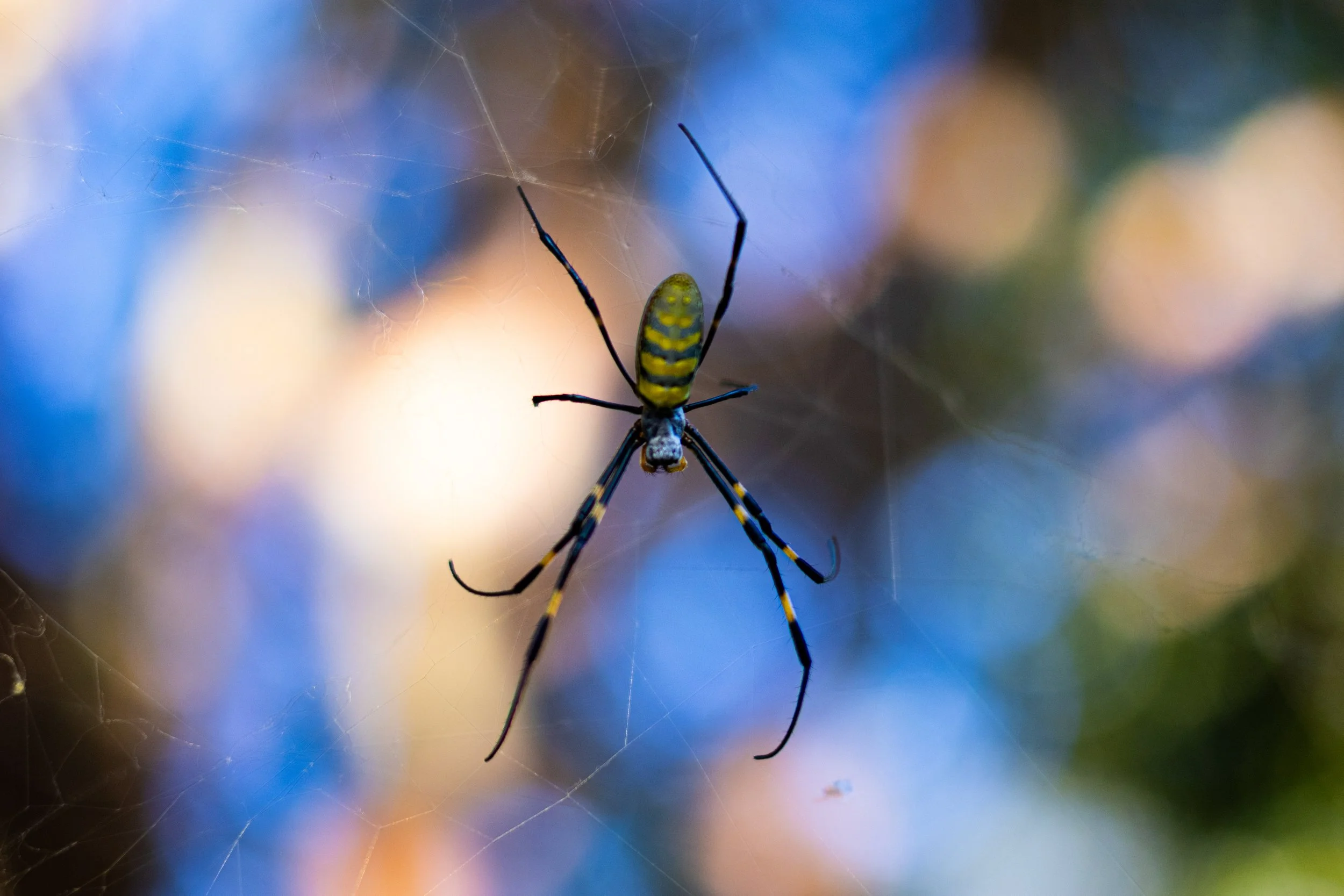
Photo courtesy of Jacob Davick
They came from beyond. They came out of nowhere. We’ve seen the signs. Or we’ve walked straight into them and tried unsuccessfully to remove their webs from our faces.
Since when was Covenant College overrun by these giant, yellow-green spiders? They seem pretty chill, but are they dangerous? How do they get so big? And aren’t they invasive?
To find out more about the spiders, I interviewed adjunct biology professor Dr. Tommy McElrath ’10. He worked as an entomologist at the Illinois Natural History Survey for eight years studying beetles before coming here to teach biodiversity, entomology, and parasitology.
Joro spiders ( Trichonephila clavata) are, indeed, invasive. “They’ve been here for about twelve years now,” McElrath said. He related how one of his colleagues at the Georgia Museum of Natural History, Dr. Rick Hoebeke, was part of the team that first identified the Joro spiders’ presence in the U.S.
How about their environmental impact? “It’s good news and bad news,” McElrath said. “It’s mostly feeding on non-native insects.” Their diets don’t cross over with native spiders very much, so, as far as researchers can tell, they’re not outcompeting native species, outcompeting native species like the golden silk orb weaver.
“They’re probably here to stay,” McElrath said, citing their current range along the southeastern coast. He related how early containment and eradication efforts were understaffed and lacked funding, referring to the successful eradication of the Asian northern hornet from the U.S. within two years in 2021. “An ounce of prevention is worth a pound of cure, unfortunately in this case.”
Like other orb weavers, Joro spiders are resistant to the cold and can even survive brief frosts, enabling them to spread to states with temperate climates. McElrath identified two ways orb weavers do this.
Adults will find a warm spot to spend the winter in a hibernation-like state called quiescence, or they will make a special egg sac that is insulated from the cold and hatches in the spring.
Joros use the egg sac method. Joro spiders can grow up to an inch in length with a leg span of up to four inches. (Imagine one curled all the way around your earbud case!) McElrath added that since the adults die off around November, “this is about as big as they’ll get.”
Joros may be cool, but they’re still invasive. When I asked what we should do about them now that they’re here, McElrath said, “Probably the best thing to do is to report them on places like iNaturalist.” These reporting apps help researchers keep track of invasive species’ range and assess their impact. “That’s probably all we can do right now.”
At the end of our conversation, McElrath brought up an important point. “Even though they are invasive, we can still appreciate their beauty here, outside their native range. All God’s creatures are wonderful, and they aren’t doing anything ‘wrong’ by being here.”